Not the boilerplate wording, which a template can hand you. The handful of decisions inside that boilerplate that actually matter, and what happens when one of them is skipped.
If you bring in a subcontractor on an email thread and a verbal "sounds good," you're not unusual. Most solo consultants and small agencies do exactly that, most of the time, and most of the time nothing goes wrong. This guide isn't about the times nothing goes wrong. It's about the specific, well-documented ways things go sideways when a subcontractor relationship has no real agreement behind it, and what a few plain clauses do to prevent each one. Nearly every clause below traces back to the same underlying fact: courts and default law don't fill gaps in your favor. If something isn't written down, it isn't assumed, and the assumption that fills the silence is rarely the one you'd have picked.
One thing this guide deliberately does not do: give you jurisdiction-specific legal advice. Contract enforceability varies a lot by state and country, especially for things like non-competes and non-solicitation clauses. Everything below is general contract-structure practice, the kind of thing worth knowing before you talk to a lawyer, not a substitute for one.
The actual legal wording of a service agreement (recitals, boilerplate "entire agreement" clauses, severability, that sort of thing) is genuinely boilerplate, and there's no reason to reinvent it or have us walk you through it line by line here. Nolo's guide to drafting a service agreement is a solid, plain-English starting template. The rest of this guide is about the handful of clauses inside a template like that which are easy to skip, easy to get wrong, and expensive when they are.
| Clause | What it actually protects against | What tends to happen if it's missing |
|---|---|---|
| IP / work-product assignment | The subcontractor keeping legal ownership of what they built for you | You only have an implied license to use the work, not to resell or hand off ownership to your own client |
| Indemnification | Being personally on the hook if the subcontractor's mistake causes a third-party claim | Courts won't assume you're covered just because it seems fair; if it's not written down, it's not there |
| Confidentiality | A subcontractor reusing or leaking something your client shared with you | No real recourse if it happens, and no way to reassure the client it won't |
| Non-solicitation | The subcontractor going around you to work with your client directly next time | You did the work of finding the client; they get to keep the relationship for free |
| Termination / kill fee | Being stuck paying a subcontractor for work you no longer need if the client's project ends early | You may owe the subcontractor for the full remaining term even though the client stopped paying you |
| Payment timing | Fronting a subcontractor's pay out of your own pocket while you're still waiting on the client's invoice | You become an unpaid short-term lender to your own business |
| Insurance requirements | An indemnification clause that's worthless because the subcontractor can't actually cover a claim | A promise to cover damages means nothing if there's no money or policy behind it |
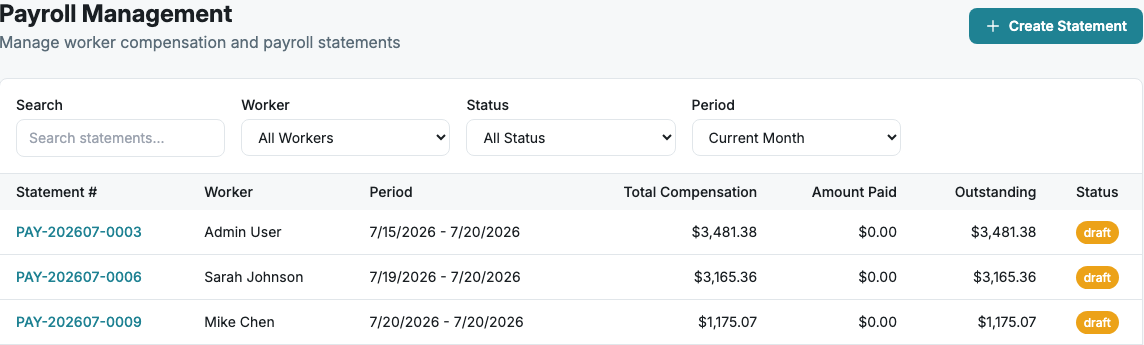
The payment-timing row is worth a second look, because it's less about the wording of the clause and more about actually knowing where you stand week to week. A subcontractor's pay and a client's invoice move on their own schedules, so the useful thing isn't the clause itself so much as a clear view of what's still outstanding on each side while you wait on both:
Here's the misconception that trips up more people than any other on this list: paying someone for creative or technical work does not automatically make you the legal owner of it. Under U.S. copyright law, whoever creates a work owns it the moment it exists, unless something specific transfers that ownership. There's a legal concept called "work made for hire" that automatically hands ownership to an employer, but it only applies cleanly to actual employees. For an independent contractor's work to count, the work has to fall into one of a handful of narrow legal categories and there has to be a signed agreement saying so. Most consulting, software, and design work doesn't fit those categories at all.
In practice, that means without an explicit line assigning ownership of the work to you, the subcontractor still owns it. You have permission to use it, but not to sell it, not to hand clean ownership of it to your own client, and not to stop the subcontractor from reusing it elsewhere. This is exactly the kind of gap that surfaces at the worst possible time: when a company is trying to raise money or get acquired, and a buyer's lawyers ask "who actually owns this code," and the honest answer turns out to be "not entirely us."
A lot of people assume that if a subcontractor's mistake causes a mess, it's obviously the subcontractor's problem to clean up. Courts don't work off "obviously." A useful real example: in Kaleel Builders, Inc. v. Ashby, a general contractor got sued by a property owner over defective construction, and tried to pass that liability on to its subcontractors even though nothing in their agreement said the subcontractors would cover it. The court refused, explaining that reading an unwritten right to pass along liability into every general contractor/subcontractor relationship would gut the basic principle that people are free to agree to whatever contract terms they actually agreed to, nothing more. The contractor was left holding the liability alone. The lesson generalizes well past construction: if you want a subcontractor to be responsible for covering claims caused by their own mistakes, that has to be written down. It won't be assumed for you.
A non-solicitation clause stops a subcontractor from cutting you out and working with your client directly. That's a reasonable thing to want; you're usually the one who found the client and built the relationship. But this is one area where jurisdiction genuinely matters and it's worth being careful: courts and regulators have gotten much stricter about broad agreements that simply try to stop people from working with certain companies or each other, especially when they look like they exist purely to suppress pay or competition rather than to protect a specific, legitimate business relationship. A narrow clause protecting a specific client relationship you brought to the table tends to hold up better than a broad one trying to lock a subcontractor out of an entire market. This is a clause worth having a real conversation with a lawyer about, specific to your state.
You don't need a thirty-page master agreement before you can bring on your first subcontractor. Most of what's above is a handful of paragraphs added to a template like Nolo's: who owns the work, who covers whose mistakes, what stays confidential, whether either side can go around the other, what happens if the project ends early, and when payment actually happens. The clauses that matter most are the ones that force you to make a decision now, in writing, instead of discovering what you'd assumed only after something's already gone wrong.