None of the three is "correct." Each one is a different way of deciding who carries the risk if a project runs long: you or the client.
Most solo consultants pick a pricing model once, early on, and then apply it to every client afterward out of habit rather than because they thought it through. That's a shame, because the three common models (hourly, fixed-fee, and retainer) aren't competing options where one is simply better. They shift risk in different directions, and the right one depends on the client and the project in front of you, not on whatever you happened to start with.
Hourly billing is the simplest to understand and the hardest to feel good about. You get paid for every hour you spend, so an expanding scope becomes more revenue for you rather than a problem. The client absorbs that risk, not you. The tradeoff is that your income is capped by hours in the day, and if you get faster or more experienced at something, your pay for that same work actually goes down, since you're now billing fewer hours for it.
Fixed-fee pricing flips that. You quote one price for a defined deliverable, and the client knows exactly what they're paying up front. That's attractive to them, but it means you're now the one absorbing the risk: if the project runs longer than estimated, every extra hour comes straight out of your margin. This is the model where a loose, poorly scoped agreement can genuinely cost you money.
Retainers trade a discount for predictability. The client pays a flat monthly fee for either a set volume of work or guaranteed access to you, and you get stable, recurring income instead of chasing new business every month. The risk here isn't scope creep on a single project, it's scope creep on the relationship. A retainer with no boundaries slowly turns into unlimited work for a fixed price unless you're explicit about what it does and doesn't cover.
| If the situation looks like this… | …this model tends to fit |
|---|---|
| Client can't yet describe the problem clearly, or it's a first engagement | Hourly, at least for a short discovery phase |
| Well-defined, repeatable deliverable (an audit, a migration, a one-off build) | Fixed-fee |
| Client needs to compare vendor quotes or get budget sign-off | Fixed-fee, the easiest to put in front of a procurement process |
| Ongoing, compounding work (retained SEO, continuous support, an embedded advisor role) | Retainer |
| Client wants priority access to you more than a specific task list | Retainer, structured as "pay for access" rather than "pay for output" |
| High-stakes work where time needs to be defensible after the fact (compliance, disputes) | Hourly, with detailed time records |
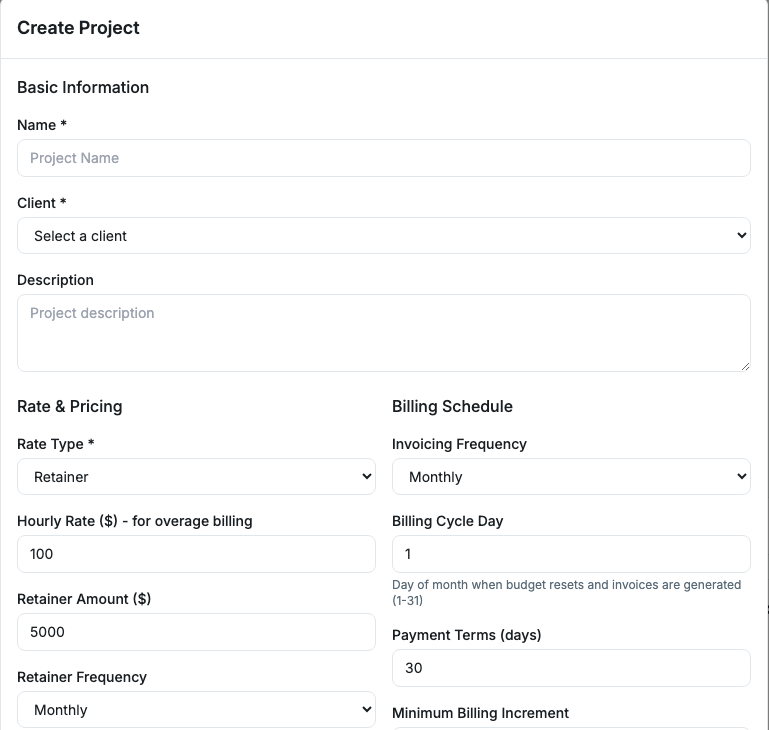
A pattern worth noticing: retainers are almost never the first thing you sell a new client. Most clients want a smaller, boundaried project first, to see how you work, before they'll commit to an open-ended monthly relationship. That also means whatever you use to run client work should let you mix models freely rather than commit your whole business to one. In Bizily, the rate type is set per project, not per account, so an hourly discovery phase with a new client and a retainer with a five-year one can sit side by side without any workaround.
A 2025 pricing survey of SEO and digital agencies by SE Ranking found 78.2% use monthly retainers as a primary model, 48.9% use project-based fixed fees, 34.8% still use hourly billing, and 9% use performance-based pricing. Those numbers add up to more than 100% because, as the survey notes, most agencies blend two or three models depending on the client rather than committing to just one, which is really the point of this whole guide: pick per client, not once for the whole business.
On rates: independent consultant hourly pricing varies enormously by field and experience. Per Consult Fees' 2026 benchmark, entry-level consultants (0–2 years) typically charge $50–$100/hour, mid-level (3–7 years) $100–$200/hour, and senior/expert consultants (8+ years) $200–$350/hour, with specialists in fields like AI/ML consulting reaching $300–$500/hour. The same source puts the median independent consultant fee in the US at roughly $150–$200/hour overall.
This is the same arithmetic trap that trips up subcontractor markups, and it shows up constantly in fixed-fee and retainer pricing: confusing markup with margin. If you want a project to leave you with a 30% profit margin, adding 30% on top of your costs doesn't get you there. It actually gets you about 23%. The real relationship is markup = margin ÷ (1 − margin), so a 30% margin actually requires a 42.9% markup, as Groundplan's breakdown of the formula lays out with a worked construction-industry example.
Retainers have a version of this same trap, and it's a big part of why so many are underpriced. A retainer pricing guide from Taskip, citing the same SE Ranking survey, notes that 64% of agencies charge below $1,000/month for retainers, a level that rarely covers the real, fully-loaded cost of the work once everything is accounted for. Their fix is a floor-price formula: divide your total true monthly cost of delivering the work by (1 minus your target profit margin). In their worked example, $2,000 in real monthly delivery cost at a 40% target margin gives a floor of $2,000 ÷ 0.60 = $3,333/month. Quote below that and you're funding the client's retainer out of your own pocket every month, not just once.
ERP consultant Tony Velasquez struggled with the standard feast-or-famine cycle of hourly implementation billing. According to Consulting Success's writeup, he moved to a value-based retainer, pricing his fee around the financial impact of the system optimization work rather than hours spent, and increased his revenue 4x without working more hours.
Virtual assistant Leslie Auman made a smaller but more relatable move: she'd been billing hourly and invoicing clients erratically whenever their hours ran out, which made her income unpredictable. In her own account of the transition, she writes that she deliberately "priced my retainers less than straight hourly to incentivize clients to choose that," phased the change in by migrating her most established clients first, and ended up with all but one client on a retainer. She's candid that she doesn't have hard numbers on the revenue impact. The win she describes is the relief of predictable income twice a month, not a documented profit jump.
We came across other pricing "case studies" in similar sources with suspiciously round, dramatic numbers (a specific cohort of independent operators all posting near-identical results in a fixed 90-day window) that we couldn't trace to a verifiable original source. We've left those out rather than repeat a number we can't stand behind.
There's no single right model to standardize on. The consultants who price well tend to match the model to the client and project in front of them: hourly for anything too undefined to quote a number on, fixed-fee for clearly bounded deliverables, retainers once a relationship has proven out and the work has become genuinely ongoing. The one mistake that cuts across all three is pricing on instinct instead of doing the markup-to-margin math, so whichever model you pick, do that part deliberately.