Equity, crypto, barter, trade credits, revenue share. What actually works, what tends to blow up, and the pattern behind which is which.
At some point almost every small consultancy or agency gets some version of this offer: a client who wants to pay in something other than money, a contractor who's willing to take equity instead of a rate, or a fellow freelancer who'd rather trade services than invoice each other. It comes up more than you'd expect, and there's surprisingly little honest writing about it. Most of what's out there is either startup-equity advice that assumes you're VC-track, or crypto-payroll marketing that assumes you're already sold on the idea.
This guide tries to actually think through when paying someone in something other than dollars is a reasonable idea, when it's a way to quietly underpay someone while feeling generous about it, and what tends to go wrong in between. One disclaimer up front: this stays out of jurisdiction-specific legal and tax advice. Whether a given arrangement is even legal, especially for employees rather than contractors, depends heavily on where you and the other party are. That's a conversation for a lawyer, not a guide.
This distinction matters more than any of the pros and cons below, so it goes first. If you're hiring an independent contractor, a freelancer, a subcontractor, another small firm, the arrangement is a commercial deal between two businesses. Within reason, you can agree to almost anything: pay entirely in equity, entirely in crypto, entirely in trade credit. They're taking that deal as a business decision, and it's on them to weigh the risk.
If you're paying a statutory employee, that freedom mostly disappears. In the US, the Fair Labor Standards Act requires wages to be paid "in cash or negotiable instrument payable at par," and courts and regulators have been clear that crypto, unvested equity, and trade credits don't qualify. California goes further still: Labor Code Section 212 requires wages to be paid in cash, on demand, with no discount. Practically, this means non-cash compensation for employees can only ever be a bonus layered on top of a fully compliant cash wage, not the wage itself. Get this backwards and you're not in a gray area. You're in wage-theft territory, with liquidated damages and legal fees attached.
Everything below assumes you already know which side of that line you're on. If you don't, that's the first thing to resolve.
Strip away the pitch decks and there are really two honest reasons non-cash compensation happens.
The first is alignment. You want the other person's outcome tied to yours. A developer who takes equity instead of a full rate has skin in the game in a way an hourly contractor doesn't. This is the oldest and most legitimate reason on the list, and it's why the SEC carved out a specific safe harbor (Rule 701) letting private companies issue up to $10 million in compensatory equity a year without the cost of a public registration. Regulators clearly consider this a normal, useful thing for a business to do, not a loophole.
The second is getting around a broken payment system, and this one shows up mostly outside the US. A freelancer in Argentina or Turkey being paid in a US-pegged stablecoin usually isn't doing it to speculate. Their own currency loses value faster than they can spend it, and a wire transfer through the correspondent banking system can take days and cost a real cut in fees. By 2025, Argentina, Cameroon, Turkey, and Vietnam led the world in contractors asking to be paid in stablecoins rather than local currency. In Argentina specifically, over 84% of contractors paid through employer-of-record platforms chose USD or a USD-pegged stablecoin over the peso (figures from Deel's 2026 Global Hiring Report). That's less a crypto trend than a currency-stability workaround that happens to use crypto rails.
There's a third, quieter reason too: idle capacity. A consulting firm with unbilled hours, or a hotel with empty rooms, can trade that capacity through a barter exchange for things it would otherwise pay cash for, office supplies, ad space, whatever. It's not glamorous, but the International Reciprocal Trade Association estimates the organized barter industry at $12–14 billion a year globally, and most of that is exactly this kind of trade rather than the informal "I'll build your website if you do my taxes" version between two freelancers.
One thing worth naming before going further: a lot of what's written about this topic online reads like a pitch. SEC safe harbors, macro-stability studies on the Swiss WIR Bank, talk of "aligning incentives" and cross-border efficiency. The framing is almost uniformly upbeat, as if the only thing standing between you and a smarter compensation strategy is not having heard of it yet. Trace the specific court cases and regulatory guidance that same material cites, though, and the picture is a lot more sobering: lawsuits over undocumented sweat-equity deals, wage-law violations, a currency system that collapsed into hyperinflation. It's worth reading anything on this topic, including this guide, with that gap between the tone and the evidence in mind.
Two numbers worth sitting with. In Argentina, over 84% of contractors paid through employer-of-record platforms now ask to be paid in USD or a USD-pegged stablecoin rather than pesos, a rational response to a currency that loses value faster than they can spend it. And in one of the better-documented sweat-equity disputes on record, an informal, never-valued equity arrangement between former partners ended in a $15.7 million judgment after a three-week trial. Same underlying idea, paying in something other than cash, but the outcomes couldn't be more different, depending entirely on whether the terms were pinned down.
Read enough of the disputes and lawsuits around non-cash compensation and a pattern shows up. Nearly every bad outcome traces back to one of two failures: nobody wrote down what the thing was actually worth, or one side ended up holding an asset they couldn't spend.
The valuation problem is the more common one. Two people agree, informally, that some work is worth "a stake in the company" or "some trade credits," and neither side pins down a number at the time. Everyone's aligned while the relationship is good. Then it ends, and it turns out each side had a very different number in their head the whole time. That's the shape of the dispute in Charron v. DeBlasio, where a "sweat equity" partnership that was never cleanly valued up front led to a three-week trial and a $15.7 million judgment once the partners split and had to work out what the company was actually worth. It's also what happened to the founders behind the cannabis-accessory brand Session, who contributed sweat equity on a handshake, were pushed out, and lost their promised shares because nothing had been formalized. Equity itself isn't the problem. An informal valuation is a bet that the relationship stays good forever, and relationships don't reliably do that.
The illiquidity problem is simpler and more common day to day: you can't pay rent with an asset nobody will buy. A contractor holding unvested startup equity, an obscure token with no real trading market, or trade credits redeemable only within one closed network has taken on real risk that a cash-paid contractor hasn't. If the company folds, the token crashes, or the barter network dissolves, the work already happened and there's nothing to show for it. It's a more sophisticated-sounding version of "paid in exposure."
There's a third, less obvious failure mode worth knowing about, because it's a warning about alternative currencies generally rather than any one deal: what happens when the currency itself isn't trustworthy. During Argentina's 1998–2002 economic crisis, informal barter networks using a local scrip called the Crédito grew to an estimated 2.5 million participants, and it genuinely worked for a while. But with no central authority controlling supply, competing network operators kept printing more of it to extract value for themselves, and the whole system collapsed into its own private hyperinflation by 2002. The WIR Bank in Switzerland is the counterexample: a mutual-credit system that's operated since 1934, holds billions in assets, and actually helps buffer Swiss small businesses during credit crunches, mostly because it's tightly governed and was never allowed to devolve into uncontrolled issuance. Same basic idea, opposite outcome. The difference is governance and discipline, not whether alternative currency is a good idea in principle.
It's tempting to treat cryptocurrency as its own separate category, but for a small consultancy it's mostly just a faster, more volatile version of the same trade-offs above. Paying a contractor in a stablecoin is functionally close to paying them in a foreign currency they've asked for, quickly and without a bank in the middle. Paying them in a native or utility token is a lot closer to giving them equity: upside if the project succeeds, close to worthless if it doesn't.
The one crypto-specific trap worth naming clearly: tax authorities don't care that it's not a bank transfer. In the US, the IRS treats crypto as property, not currency. A contractor paid in crypto owes ordinary income tax on its dollar value the moment they receive it, plus capital gains or losses when they eventually sell it, regardless of what it's worth by then. That's a genuinely painful trap: you can owe tax on a value the asset no longer has. The same basic principle, taxable at fair market value on receipt, applies to plain old barter too, per the IRS. The Tax Court has ruled on this more than once. In Baker v. Commissioner, someone who received barter-exchange credits as payment argued they should be taxed at a discount because the exchange's internal pricing was inflated, and the court said no. Face value counts, whether or not real money changed hands.
| Type | Tends to work when | Tends to go badly when |
|---|---|---|
| Equity / sweat equity | Early-stage, high-upside company; recipient understands and accepts the risk; vesting is written down before work starts | Used for short-term or one-off work; valuation was ever just a verbal understanding |
| Stablecoin payment | Recipient specifically asked for it, often because their local currency or banking access is the problem | Used to avoid paying someone properly, or as a substitute for a compliant wage to an employee |
| Native / utility token | Recipient is knowingly betting on a specific project's success, same as equity | The token has no real trading market, or you haven't checked whether issuing it could count as an unregistered security |
| Barter / trade credit | You have real idle capacity (unbilled hours, unused space) and a network with liquidity beyond just you and one trading partner | It's really an informal one-off favor being dressed up as a business arrangement, with no clear value attached |
| Revenue share | The recipient's own work visibly drives the revenue being shared (sales, affiliate, go-to-market) | Applied to roles where individual contribution to revenue can't really be traced (most operational or engineering work) |
This is a general pattern, not a rule. The details of a specific deal matter more than the category it falls into.
Nearly every failure mode above traces back to the same missing step: nobody wrote down, in advance, what the non-cash thing was actually worth at the time of the exchange. Below is what that looks like in practice, not a full legal template, but the specific decisions worth making explicit before work starts.
Practically, this doesn't need to be complicated. If you're the kind of shop that tracks worker rates and project billing in Bizily, the same place you'd set a normal hourly or fixed rate lets you define a currency label of your own, something like "Trade Credits" or "Token Allocation," and attach it to a worker's rate or a project the same way you would dollars. It's worth being precise about what that is and isn't: a label and a formatting rule, not an exchange-rate engine or a wallet. It doesn't convert your trade credits to dollars for you, and it doesn't track a live token price. What it does is make sure the number you agreed to gets recorded consistently, on the invoice and the payroll statement, in the unit you actually agreed to pay in, instead of living only in an email thread or somebody's memory.
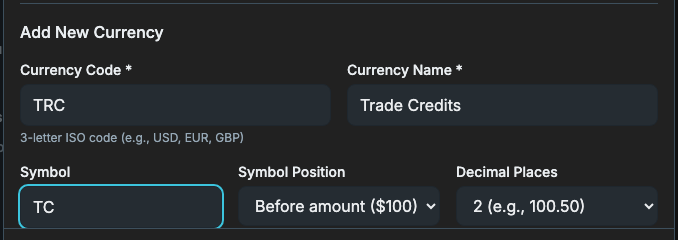
Worth being clear-eyed about what a feature like this can and can't do for you. It helps with exactly the failure mode this guide keeps coming back to: a number that only ever lived in an email thread or somebody's memory. Recorded consistently on the worker's rate, the project, and the payroll statement, that number is much harder to quietly renegotiate after the fact, which is a real, useful thing for both sides. What it can't do is tell you whether the underlying deal is fair. It doesn't know whether the currency you've defined is a good-faith arrangement or a cash rate in disguise, and it never will, because that judgment isn't something record-keeping can make for you. The tool earns its keep once the terms are fair. It's on you to get the terms there first.
Non-cash compensation isn't a trick and it isn't automatically exploitative. It's a real tool that fits a narrow set of situations well: genuine upside-sharing with someone who's choosing to bet alongside you, or solving a real cross-border payment problem for someone who asked for it. It fits most other situations badly, because it quietly shifts risk from the party asking for the work onto the party doing it. The data on how often it's used informally is thin almost by definition, since most of these arrangements never show up in a survey; they're one line in somebody's email. That's exactly why writing the terms down matters more here than in an ordinary cash deal.
A note on sourcing: the underlying research for this guide also surfaced claims we couldn't verify to our own satisfaction, in particular how enforceable smart-contract-based payment terms actually are across borders, and the durability of the current legal position that most utility tokens fall outside securities regulation. Both are live, unsettled questions, not established facts, so we've left them out of the guide above rather than stating them as settled.